The Arc of a Covenant: The United States, Israel, and the Fate of the Jewish People by Walter Russell Mead
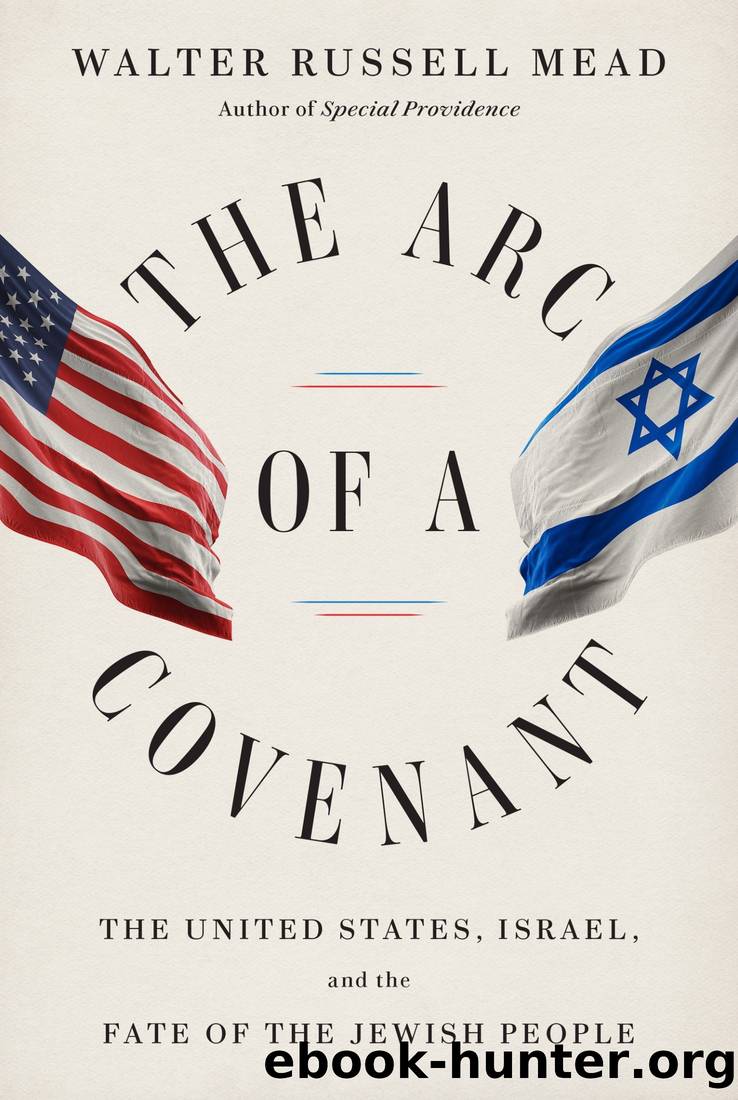
Author:Walter Russell Mead [Mead, Walter Russell]
Language: eng
Format: epub
ISBN: 9780375414046
Publisher: Knopf
Published: 2022-07-05T00:00:00+00:00
* * *
Americans were, to use a phrase that Joseph Stalin made famous in 1930, âdizzy with successâ[1] after the fall of the Berlin Wall. Many agreed that the end of the Cold War and the collapse of the Soviet Union meant what Francis Fukuyama called the âend of history.â They believed, for the most part, that the unipolar moment in world politics that followed the USSRâs demise could be converted into a lasting democratic peace around the world. American power deployed in the service of a rules-based international order could secure vital American and western security and economic interests at minimal risk and with low costs. Opening the system to rising powers like China and India would improve economic outcomes for all countries, integrate the new powers into not just the structures but also the values of the American system, and promote rising standards of living around the world.
These policies, American elites generally felt, would not just promote a peaceful world, they would enhance the prosperity of the American people. In what some called âa great moderation,â on economic issues Democrats were moving right and Republicans were moving left. The chief instrument of social progress, leading Americans believed, was the rapid growth facilitated by a deregulated economy and a dynamic financial sector. What was good for Wall Street, with relatively few exceptions, was good for the country. And what was good for the country was good for the world. While the parties differed on the details, they agreed that on the whole only modest interventions would be required to make the United States a more just society. Racial inequality was believed to be on the road to extinction. While social problems remained, progress was possible without wrenching changes to the status quo.
The first two decades of the new century, however, witnessed a series of shocks to the optimism and confidence of postâCold War era triumphalism. Beginning with the 9/11 attacks in 2001, continuing with the unhappy wars in Afghanistan and Iraq and the financial crisis of 2007â09, world events diverged from the path many Americans once confidently assumed they would take. As the global wave of democratization subsided and went into reverse, as Russia and China moved increasingly aggressively to counter American power, as automation and losses to foreign competition created new problems for the American middle class, and as the Covid-19 pandemic stunned the world and sent the global economy spiraling into its sharpest contraction on record, the gap between the future that the American establishment had expected and prepared for and the future that had actually arrived gradually became too wide to ignore.
Over time these developments led to an erosion of political support for postâCold War global policy, a rise in antiestablishment political movements on the right and the left, and to a rupture in the previously dominant Sun Belt coalition that broke the continuity of Republican Party leadership and policy. The rise of a socialist left and an ultranationalist right were disquieting signs that many Americans had lost faith in the American economic and political system.
Download
This site does not store any files on its server. We only index and link to content provided by other sites. Please contact the content providers to delete copyright contents if any and email us, we'll remove relevant links or contents immediately.
| Arms Control | Diplomacy |
| Security | Trades & Tariffs |
| Treaties | African |
| Asian | Australian & Oceanian |
| Canadian | Caribbean & Latin American |
| European | Middle Eastern |
| Russian & Former Soviet Union |
The Secret History by Donna Tartt(19088)
The Social Justice Warrior Handbook by Lisa De Pasquale(12190)
Thirteen Reasons Why by Jay Asher(8910)
This Is How You Lose Her by Junot Diaz(6887)
Weapons of Math Destruction by Cathy O'Neil(6280)
Zero to One by Peter Thiel(5802)
Beartown by Fredrik Backman(5754)
The Myth of the Strong Leader by Archie Brown(5507)
The Fire Next Time by James Baldwin(5446)
How Democracies Die by Steven Levitsky & Daniel Ziblatt(5219)
Promise Me, Dad by Joe Biden(5153)
Stone's Rules by Roger Stone(5088)
A Higher Loyalty: Truth, Lies, and Leadership by James Comey(4964)
100 Deadly Skills by Clint Emerson(4925)
Rise and Kill First by Ronen Bergman(4789)
Secrecy World by Jake Bernstein(4753)
The David Icke Guide to the Global Conspiracy (and how to end it) by David Icke(4720)
The Farm by Tom Rob Smith(4513)
The Doomsday Machine by Daniel Ellsberg(4490)
